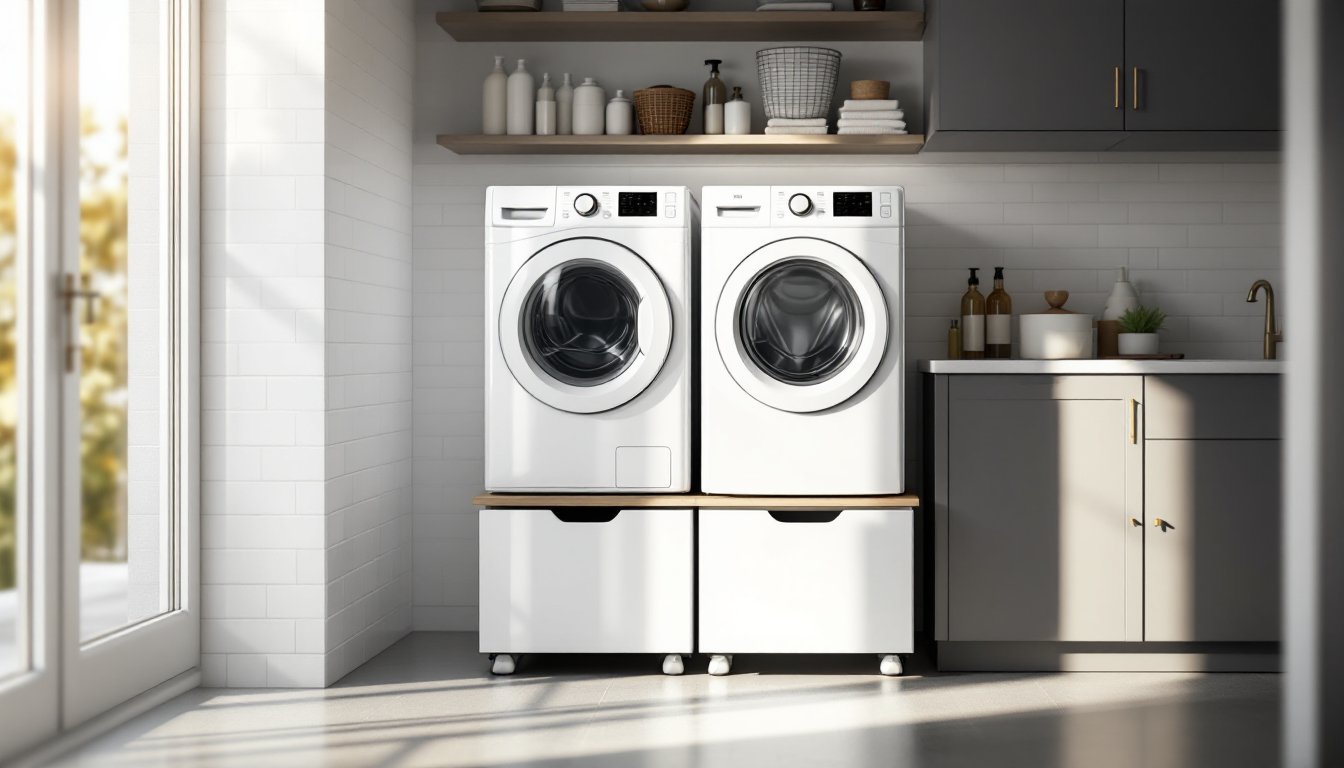
Washer and dryer pedestals are one of those purchases that sounds optional until you actually install one, then you wonder why you waited so long. They lift your laundry appliances off the floor, saving your back during loading and unloading while creating useful storage space underneath. Whether you’re dealing with a cramped laundry room, bad knees, or simply want a more organized setup, a pedestal can transform how you do laundry. This guide covers what pedestals are, the main types available, why they matter for your home, and how to pick the right one for your specific washer and dryer.
Table of Contents
ToggleKey Takeaways
- A pedestal for washer and dryer raises your appliances 12 to 18 inches off the floor, significantly reducing back strain during loading and unloading while improving ergonomics for anyone with mobility issues.
- Storage pedestals with drawers provide 1.5 to 3 cubic feet of space for laundry supplies and typically cost $150–$400, while simple riser pedestals offer height without storage for $100–$200.
- Pedestals must match your specific appliance model and weight capacity, as they’re engineered by manufacturers like Whirlpool, LG, Samsung, and GE to handle dynamic loads of 300+ pounds for a loaded front-load washer.
- Beyond ergonomics, a pedestal for washer and dryer improves airflow, reduces moisture buildup that can cause mold, and creates a more organized, finished appearance in your laundry room.
- Installation requires proper leveling, securing the appliance with bolts or anti-tip clips, and testing stability—ideally with a second person to safely maneuver heavy machines onto the pedestal.
- Mid-range pedestals ($150–$250) offer the best value with durable construction and soft-close drawers, making them the ideal choice for most households over budget or premium models.
What Is a Washer and Dryer Pedestal?
A washer and dryer pedestal is a platform or elevated base designed to raise your appliance 12 to 18 inches off the floor. Most pedestals are manufactured by the same companies that make the washers and dryers themselves, Whirlpool, LG, Samsung, GE, and they’re engineered to match your specific model’s dimensions and weight capacity. Think of it as a sturdy box with rubber feet and a stable frame that your appliance sits on. The pedestal bears the full weight of a loaded machine, so it’s not something you can DIY from scrap wood: these are precision-engineered to handle dynamic loads and vibration. The height gain is meaningful, instead of bending to ground level, you’re working at waist height, which takes a real toll off your body during the weekly laundry routine.
Types of Pedestals Available
Storage Pedestals With Drawers
The most popular option is a storage pedestal with one or two drawers underneath. These typically offer between 1.5 and 3 cubic feet of space, perfect for holding detergent, dryer sheets, cleaning supplies, or seasonal items you don’t access daily. Drawer pedestals usually cost between $150 and $400, depending on build quality and material. The drawers slide smoothly on ball-bearing slides and include soft-close mechanisms on mid-to-premium models. You’ll want to ensure the drawer depth doesn’t exceed your laundry room layout, measure the space behind your washer before ordering, since a pedestal with a drawer may stick out further than the appliance itself. Storage pedestals add genuine utility without requiring any modification to your appliances.
Simple Riser Pedestals
If you don’t need storage, a simple riser pedestal does one thing: raises the machine. These solid platforms typically cost $100 to $200 and take up minimal floor space. They’re lighter than storage models and easier to move if you’re rearranging your laundry room. Some homeowners use risers when they’ve already got compact shelving or cabinets nearby, or when floor space is extremely tight. Riser pedestals are straightforward installations, typically just four bolts or clips, with no moving parts to wear out. They’re the practical choice if you want height without complexity.
Key Benefits for Your Home
Ergonomics is the primary win. Loading a front-load washer at waist height instead of bending to your shins cuts strain on your back, knees, and hips. If anyone in your household has mobility issues or chronic pain, a pedestal isn’t a luxury, it’s functional relief. Space efficiency comes next, especially with storage models. That dead space under your washer becomes usable square footage for supplies you actually use weekly. In a compact laundry room, this can free up wall space for shelving or allow you to fit an additional appliance. Airflow and maintenance improve too. Pedestals lift machines off the floor, allowing better air circulation and making it easier to clean around the base and lint trap. They also reduce moisture accumulation underneath, which can lead to mold or mildew in poorly ventilated spaces. Finally, pedestals add a finished look to your laundry area. Rather than machines sitting directly on linoleum or concrete, they sit on a proper platform, making the space feel more intentional and organized.
How to Choose the Right Pedestal
First, verify your appliance model and weight. Pedestals aren’t universal, a pedestal made for an LG front-loader won’t fit a Whirlpool washer. Check your washer or dryer’s spec sheet for the exact model number, then confirm the pedestal’s compatibility. You’ll also need the empty weight of your appliance (usually 80–100 pounds for a washer, 60–85 for a dryer), since the pedestal’s weight capacity must exceed your machine plus a full load of wet laundry. A loaded front-load washer can weigh 300+ pounds, so this matters. Measure your laundry room, specifically the space between the appliances, the back wall, and any doorways. Pedestals add depth, so ensure you can still open doors or access connections in the rear. If you’re stacking a dryer on top of a washer, check that a pedestal won’t make the dryer unreachable or block ventilation. Decide on storage. If your laundry room lacks cabinet or shelf space and you’re constantly hunting for detergent, a storage pedestal justifies the extra $100–$200. If you have storage elsewhere or prefer a minimal footprint, a riser pedestal works fine. Budget and build quality vary. Mid-range pedestals ($150–$250) are solid, durable, and include soft-close drawers. Budget models ($80–$120) work but may have stiffer drawer action or simpler finishes. Premium pedestals ($300+) add features like integrated LED lighting, sanitizing cycles, or premium materials. For most households, mid-range is the sweet spot.
Installation and Setup Tips
Installation is straightforward for most pedestals, but preparation matters. Start by unpacking and inspecting the pedestal for shipping damage, the bottom rails and drawer mechanisms are vulnerable in transit. Lay it on its back in your laundry room so you can attach the feet or rubber bumpers to the underside if they’re not pre-installed. Position the pedestal exactly where the appliance will sit, using a level to check that it’s not tilted. An out-of-level base can cause vibration during spin cycles and uneven weight distribution. Slide or carefully roll your washer or dryer onto the pedestal, this is where a second person helps. Washers especially can be awkward to maneuver, and a dropped machine can damage both the appliance and the pedestal. If you’re working alone, ask a friend or family member to assist: it’s not worth risking injury. Secure the appliance to the pedestal using the bolts, L-brackets, or anti-tip clips included in the hardware kit. Your appliance manual will specify the exact attachment method. Tighten these firmly but don’t over-torque, which can crack plastic mounting points. Test the pedestal’s stability by gently pushing on the corners of the washer: there should be no rocking or shifting. Run an empty wash and dry cycle to confirm the pedestal absorbs vibration smoothly without squeaks or movement. If you’ve got a storage pedestal, test each drawer to ensure it glides smoothly and closes securely. Consult your appliance’s manual for the complete installation sequence: modern washers and dryers may require door-lock calibration or drum-spin checks after installation.