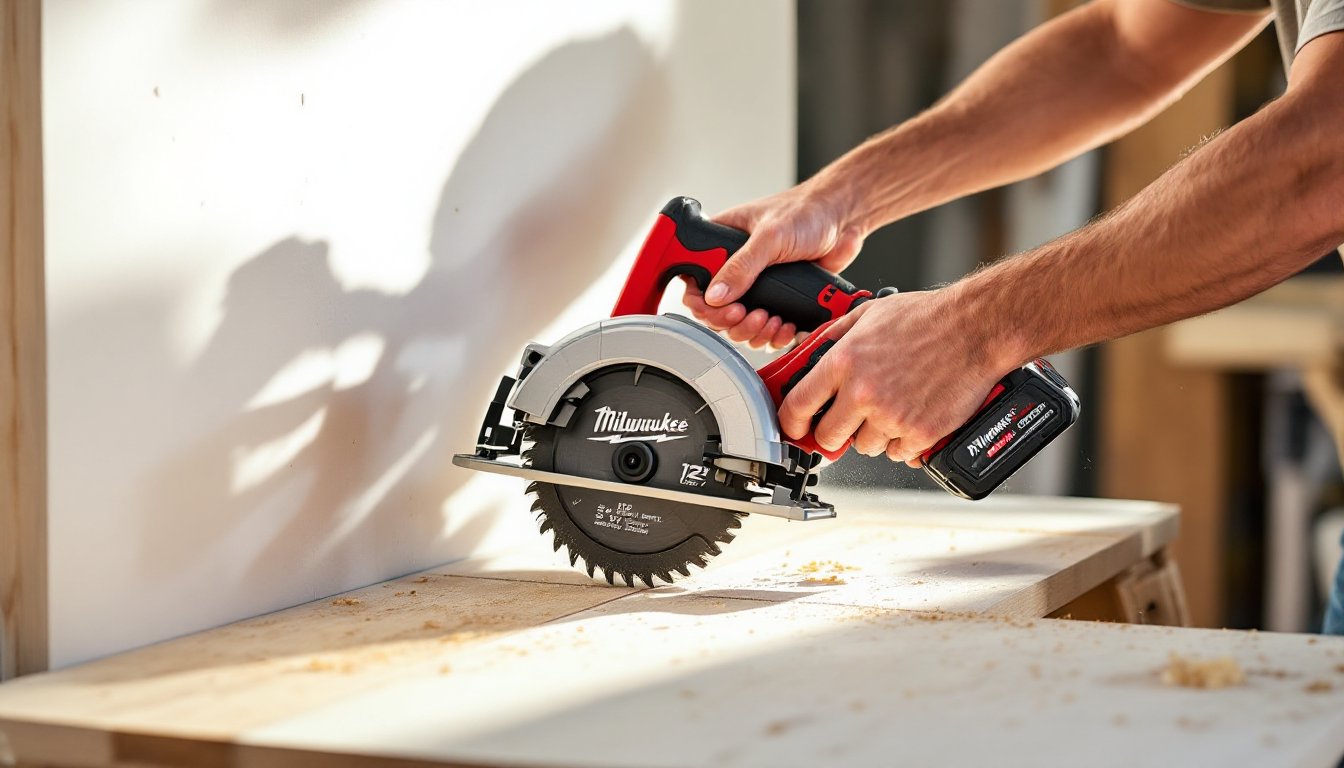
When you’re standing in a cramped attic or leaning into a tight corner, a full-size circular saw feels like you’re wrestling a bear. That’s where the Milwaukee M12 circular saw steps in, a 12-volt compact tool that packs real cutting power without the bulk. Whether you’re trimming trim boards, crosscutting framing lumber, or slicing through underlayment, this tool has become a go-to for homeowners tackling everything from small repairs to larger remodels. The appeal isn’t just the size: it’s the blend of performance, battery ecosystem, and ease of use that makes it genuinely useful in a toolbox.
Table of Contents
ToggleKey Takeaways
- The Milwaukee M12 circular saw balances portability with legitimate cutting capacity, filling a practical gap for homeowners tackling trim work, plywood cuts, and light framing projects without the bulk of full-size saws.
- With a 5 3/8-inch blade delivering a maximum cutting depth of 1 7/8 inches at 90 degrees, the M12 excels at trim carpentry and standard plywood crosscutting but requires flipping material for deeper cuts like 2×12 joists.
- Runtime on a 3.0 Ah battery typically ranges from 30–50 minutes of mixed cutting, so keeping two charged batteries allows continuous work flow and costs under $100 extra.
- Proper safety fundamentals—ANSI-approved eye protection, dust masks for harmful materials, hearing protection, and correct grip technique—are essential to prevent kickback and fatigue-related incidents.
- The M12’s integration with Milwaukee’s battery ecosystem saves money and workshop space if you already own other M12 tools like drills or impact drivers.
- Regular maintenance including blade cleaning, battery storage in cool conditions, shoe wiping, and periodic blade sharpening extends the tool’s lifespan and ensures reliable performance for years.
What Makes The Milwaukee M12 A Smart Choice For Homeowners
The M12 circular saw fills a real gap in the DIY toolkit. Unlike corded saws that tether you to an outlet, or bulky 18-volt batteries that exhaust your arms, the M12 balances portability with legitimate cutting capacity. A homeowner can reach above-head cuts without fatigue, slip it into a tool bag for job-site hopping, or store it without claiming half a shelf.
Size isn’t the only advantage. The M12 platform integrates with Milwaukee’s M12 battery ecosystem, if you already own other M12 tools like a drill or impact driver, you’re sharing batteries and chargers, which saves money and reduces clutter in your workshop. The learning curve is nearly flat: anyone who’s used a corded circular saw will immediately recognize the controls and cutting patterns.
Reliability matters too. Milwaukee tools are built for repeated use, and this saw doesn’t cut corners on motor quality or blade engagement. Job-site reviews consistently show that DIYers return to the M12 because it simply works. For cosmetic projects and light framing work, which covers most homeowner tasks, it delivers without requiring a trip to the rental center or a professional contractor.
Key Features And Specifications Worth Knowing
Understanding the specs helps you match this saw to your actual work.
The blade diameter is 5 3/8 inches, smaller than a standard 7 1/4-inch circular saw. This limits maximum cutting depth to roughly 1 7/8 inches at 90 degrees and about 1 1/4 inches at a 45-degree bevel. That’s enough for most trim, plywood, and single-pass framing cuts, just not for 2×12 joists in one go. The motor delivers around 3,000 to 3,500 RPM depending on load, which is sufficient for clean crosscuts and rip cuts in softwood and most plywood.
Blade engagement is positive. The M12 uses a standard 5/8-inch arbor, so any circular saw blade in that size works, no proprietary nonsense. Switching between a 60-tooth finish blade for trim and a 24-tooth framing blade takes 30 seconds with an arbor wrench.
The shoe (base plate) is aluminum and adjusts smoothly for bevel cuts from 0 to 50 degrees. A dust blower port keeps the cut line visible, which beats squinting through grit. The onboard laser guide is optional on some models, nice to have, not essential if you’re measuring and marking accurately.
Battery Power And Runtime Performance
Runtime is the practical spec. A 3.0 Ah M12 battery typically delivers 30 to 50 minutes of mixed cutting, enough to frame a wall section or trim out a room without swapping cells. Pushing harder (ripping dense hardwood or making bevel cuts continuously) reduces that window to 20-25 minutes. Most DIYers keep two batteries charged and rotate them, which costs under $100 extra but keeps work flowing.
Charge time on the standard M12 charger is about 30 minutes for a 3.0 Ah pack, making a mid-project battery swap painless. High-output batteries (6.0 Ah) exist and deliver longer runtime but add weight and cost, overkill for most homeowner work. The real value is having a spare battery so downtime vanishes.
How To Use Your Milwaukee M12 Circular Saw Safely And Effectively
Safety isn’t optional: it’s the foundation of using this tool confidently.
Always wear safety glasses, and not the cheap kind draped on your forehead. Use ANSI-approved polycarbonate or impact-resistant lenses that fit snugly and protect side angles. Dust is inevitable: a dust mask or respirator becomes non-negotiable if you’re cutting pressure-treated lumber, fiberglass, or MDF, materials that release harmful particles. Hearing protection (earplugs or muffs at 80+ decibels) saves your ears during extended cutting sessions.
Grip and stance matter. Hold the saw with both hands, dominant hand on the trigger grip and non-dominant hand on the handle just behind the motor housing. Keep your body slightly to the side, never directly behind the blade. This position prevents kickback from throwing the saw violently toward you. Kickback happens when a blade binds: proper grip and feed rate prevent most incidents.
Let the blade reach full speed before contacting the material. Don’t force the saw through thick material: let the motor and blade do the work. If the motor bogs down (slows noticeably), pull back slightly and let it recover. Pushing too hard dulls the blade faster and exhausts the battery.
For crosscuts, use a square or speed square to mark your line clearly. A clamped straightedge (a level, a factory-edge board, or a clamp-on guide rail) keeps rip cuts straight and true without wrestling the saw. When cutting plywood, support both sides of the cut to prevent pinching or tearout. For bevel cuts, set your angle on the shoe before starting, trying to adjust mid-cut causes wandering and poor results.
Never reach under or over a running blade, even briefly. Unplug or remove the battery before changing blades or clearing jams. Let the blade stop completely, it spins down within 5-10 seconds of releasing the trigger, before touching anything near the blade.
A work surface at elbow height reduces fatigue and improves control. Sawhorses, a workbench, or a tailgate height works well. Cutting while standing on a ladder or awkward angle compounds safety risk and accuracy problems.
Best Projects For Your Compact Circular Saw
The M12 shines on work that doesn’t demand maximum depth or power.
Trim carpentry is its sweet spot. Cutting 1×4 or 1×6 boards to length for baseboard, casing, or shelf cleats is effortless. The compact body lets you work in cramped corners or overhead installs where a full-size saw becomes cumbersome. A fine-toothed blade and steady feed deliver clean edges that need minimal sanding.
Plywood and OSB crosscutting works smoothly for most projects, shelving, cabinet backs, or underlayment for flooring. The saw cuts through standard 3/4-inch plywood in a single pass and handles 1/2-inch material with no strain. For ripping plywood lengthwise, a clamp-on guide rail turns the process into a straight, predictable operation.
Light framing tasks, cutting studs, blocking, or joists for non-structural infill, are entirely doable. The depth limitation means you won’t cut a full 2×12 or 2×10 in one pass, but you can flip the board and complete the cut from the back, which most DIYers do anyway. Splitting the cut on deep material prevents blade overheating and keeps the motor from straining.
Projects best avoided or delegated: Ripping 2×12 joists for floor framing in a single pass: cutting hardwood edges that demand mirror-smooth finishes (a table saw is worth the setup): or any project requiring hundreds of linear feet of cuts. On large jobs, a corded or gas-powered saw saves battery and motor wear. Structural work requiring engineering loads should involve a professional, a DIYer cutting critical framing pieces should confirm local building codes and get advice from a structural engineer if there’s any doubt.
Research from This Old House’s circular saw reviews shows that compact models excel at finish work and light demolition, which aligns with what homeowners actually use them for most often. For validation of your project scope, Today’s Homeowner maintenance guides often break down whether a task is DIY-friendly or calls for a licensed professional.
Maintenance Tips To Keep Your Tool In Top Condition
Preventive care extends the life of your M12 significantly.
Blade cleanliness is the first step. After each use, wipe the blade with a dry cloth or compressed air to remove dust and pitch buildup. Pitch accumulation causes poor cuts and overheats the motor. If pitch builds up (sticky residue from wood resins), soak the blade in a degreaser like mineral spirits for an hour, then scrub with a brush and dry thoroughly before reinstalling.
Batteries need respect. Store them in a cool, dry place, not in direct sunlight or a hot vehicle. Extreme heat reduces capacity and lifespan. Check contacts regularly: if they look corroded (white or green deposits), wipe them clean with a dry cloth. Don’t leave batteries in the charger permanently after they’re full: most modern Milwaukee chargers auto-shut off, but it’s good practice to unplug after charging completes.
The shoe and fence accumulate dust. A quick wipe after use keeps them moving smoothly and prevents binding during angle adjustments. If the shoe feels gritty or sticky, a compressed-air blast removes embedded debris.
Blade sharpening keeps performance sharp. A dull blade forces you to push harder, drains the battery faster, and risks motor strain. Sharpening services run $10–$20 per blade: if you use the saw regularly, maintain two or three blades so one’s always fresh while another is at the sharpening service.
Motor vents on the housing should stay clear. Blocked vents trap heat and reduce motor life. A brief compressed-air cleaning every few months prevents overheating, especially if you work in dusty environments.
If the saw starts bogging down under normal load, a dull blade is usually the culprit, sharpen or replace it first before suspecting the motor. Popular Mechanics’ tool guides offer additional troubleshooting steps if issues persist beyond basic maintenance. Store the saw in its case or a tool bag to protect it from impact and moisture. A simple routine keeps this compact tool working reliably for years.
Conclusion
The Milwaukee M12 circular saw is a practical, hardworking tool for homeowners and DIY enthusiasts who prioritize portability and genuine cutting capacity. It won’t replace a full-size saw on heavy framing jobs, but for trim, plywood, light framing, and demolition work, the bulk of what homeowners actually tackle, it delivers. Pair it with solid technique, proper safety habits, and a bit of maintenance, and you’ve got a tool that earns its place in the shop for years to come.