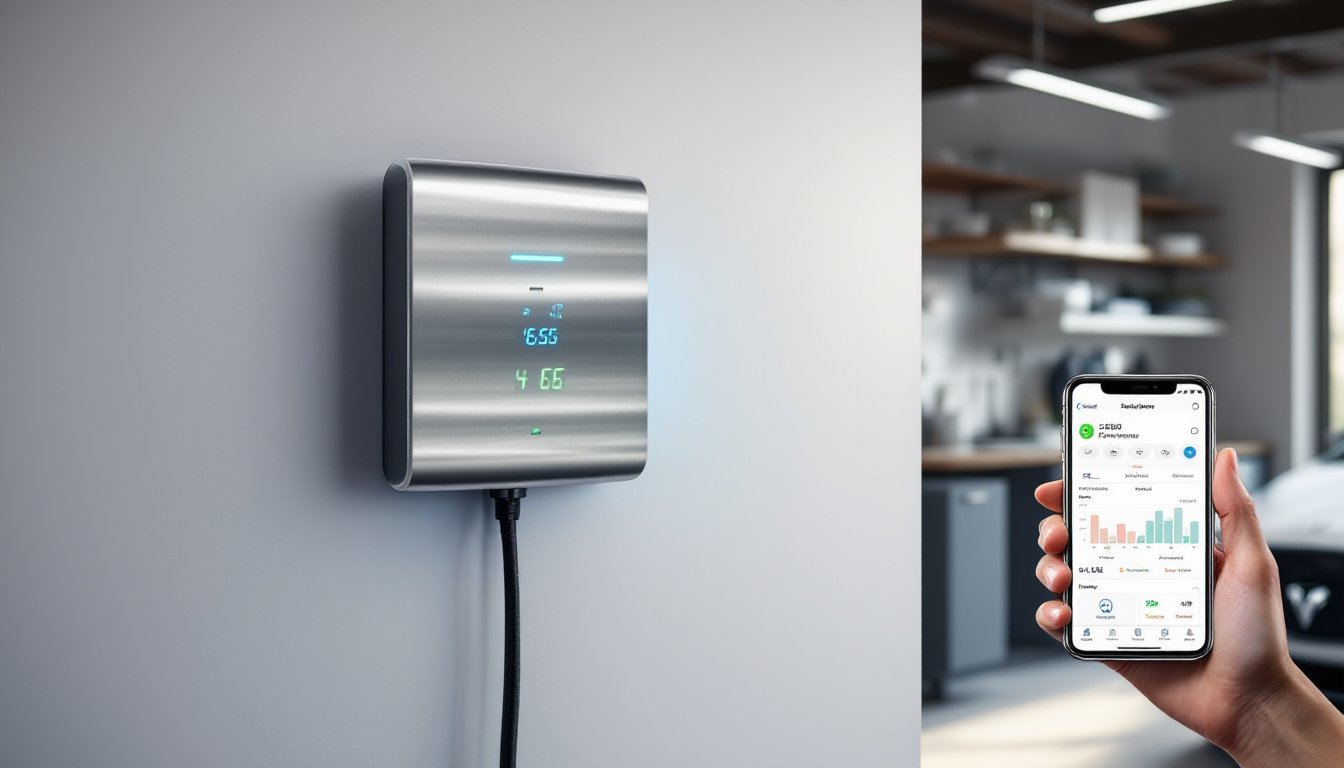
If you own an electric vehicle or plan to buy one soon, a smart EV home charger is one of the most practical upgrades you can make. Unlike basic Level 2 chargers that simply plug in and charge, smart chargers let you monitor energy use, schedule charging during off-peak hours, and integrate with your home’s electrical system, saving time and money in the process. Whether you’re installing your first charger or upgrading from a dumb model, this guide walks through what smart chargers do, what features actually matter, and how to set one up correctly.
Table of Contents
ToggleKey Takeaways
- A smart EV home charger enables remote monitoring, scheduling, and energy optimization through app-based control, allowing you to charge during off-peak hours and save 30–50% on electricity costs.
- Smart chargers integrate with home energy ecosystems, solar panels, and utility time-of-use plans, helping you maximize self-consumption and reduce grid dependency.
- Professional installation by a licensed electrician is required, with typical costs of $800–$2,500 for electrical work plus $400–$1,200 for the charger itself, depending on your home’s electrical capacity and distance to installation point.
- Load management and demand response features prevent breaker trips and can earn you $50–$200 annually, while most utilities now offer incentives that recover half the installation cost within 3–5 years.
- Combining a smart EV home charger with whole-home energy management systems can reduce your overall energy bill by 15–25% and cut grid draw by up to 40% compared to standard charging.
- Permits and building inspections are mandatory in most jurisdictions to ensure compliance with electrical codes; unpermitted installations void insurance coverage.
What Is a Smart EV Home Charger?
A smart EV home charger is a Level 2 (240V) charging station that communicates with your smartphone, home network, and utility provider. Unlike standard Level 2 chargers, which are just hardwired outlets, smart chargers add software and connectivity. They measure exactly how much power you’re using, talk to your Wi-Fi network, and let you pause or start charging remotely via an app.
Most smart chargers sit between $400 and $1,200, depending on features and amperage rating (typically 32–48 amps). The hardware itself, a wall-mounted cabinet containing a contactor, relay, and metering electronics, replaces the basic receptacle you’d find on a standard Level 2 unit. When you plug in, the charger confirms the car is ready and begins delivering power at whatever rate you’ve set or the grid allows.
Think of it like the difference between a dumb thermostat and a smart one. A dumb Level 2 charger runs whenever the car is plugged in. A smart charger lets you call the shots: charge at midnight when power is cheaper, throttle back during peak demand, or have the car ready by 7 a.m. before you leave. Modern smart chargers also tie into home energy management systems, so they can coordinate with your solar array, battery storage, or other devices.
Key Features That Matter Most
Not all smart chargers pack the same features. Some are loaded with bells and whistles: others focus on the essentials. Here’s what actually moves the needle.
Remote Monitoring and Control
The most useful feature is app-based monitoring. You can check charging status, current power draw, session history, and cost from your phone, even when you’re not home. If you start charging and realize you left your garage door open, many chargers let you pause remotely.
Scheduling is the second pillar. Set the charger to start at 11 p.m. when your utility offers lower rates, or delay charging until the sun comes up if you have solar panels. Some chargers integrate with utility time-of-use plans, automatically shifting demand to cheaper windows. A handful of models support vehicle-to-home (V2H) technology, where your EV acts as a backup battery during outages, though this requires a compatible car and special hardware.
Look for Wi-Fi or cellular backup. Chargers that rely solely on Wi-Fi can lose remote features if your network goes down: cellular models (with a small monthly fee) keep working. Most also generate detailed reports: daily costs, carbon offset, kilowatt-hours delivered, useful if you’re curious about your EV’s true energy footprint.
Energy Management Integration
Smart chargers increasingly play nice with home energy ecosystems. If you run Lutron, Home Assistant, or Apple HomeKit, some chargers can report data to those platforms. A few support demand response, where your utility can briefly lower your charger’s power draw during grid stress, earning you a small rebate.
Load management is worth mentioning. If your home’s main panel only has 100 or 150 amps and you’re running the dishwasher and dryer, a smart charger can detect that spike and temporarily reduce charging amperage, keeping you from tripping a breaker. This feature requires either a sub-panel upgrade (often $1,500–$3,000) or a charger with built-in current sensing.
Solar integration is becoming standard. Chargers that talk to monitoring systems like Enphase or SolarEdge can delay charging until midday when your panels are pumping power, maximizing self-consumption and trimming grid usage.
Installation and Setup Essentials
Here’s where honesty matters: installing a smart EV charger is not a typical DIY job. You’ll need a licensed electrician, and in many jurisdictions, a permit.
The core requirement is a 240V circuit with adequate amperage. Most homes built in the last 20 years have a 200-amp main service, which leaves room for a 40 or 48-amp charger. Older homes with 100-amp or 150-amp service likely need a panel upgrade before a charger can go in safely. An electrician will run a dedicated circuit from your breaker box to the installation point, usually the garage or near your driveway. Expect 30–100 feet of copper wire, conduit, and a 240V breaker sized to the charger. Typical costs: $800–$2,500 for the electrical work alone, depending on distance and whether the panel needs upgrading.
Permits are required in most areas. Building departments want to verify that your electrical system can handle the load and that installation follows the National Electrical Code (NEC Article 625). Some jurisdictions now mandate inspections. Don’t skip this, insurance won’t cover damage from unpermitted work.
Once the electrician finishes, setup is straightforward. Hardwire the charger to the wall, power it on, and download the manufacturer’s app. You’ll create an account, connect the charger to Wi-Fi, and pair it with your vehicle. Most brands (Tesla, Wallbox, ChargePoint, Eaton) make this simple: the app guides you through it. Confirm your circuit amperage in settings so the charger doesn’t exceed your panel’s limits.
Maximizing Savings and Efficiency
Smart chargers save money in two ways: lower electricity rates and reduced panel stress.
First, time-of-use (TOU) rates. If your utility offers them (and more do every year), they’ll charge less during off-peak hours, often 9 p.m. to 7 a.m., and more during peak. A smart charger lets you exploit that gap. Charging at midnight instead of 6 p.m. can cut your per-kilowatt cost by 30–50%, depending on your utility. Over a year, that’s $300–$600 for the average EV owner. Schedule charging automatically, and you never have to think about it.
Second, demand response and load shifting. Some utilities will pay you to let them reduce your charger’s power during peak demand events (usually a few hours on hot summer afternoons). Payouts aren’t huge, $50–$200 per year, but they offset the charger’s cost over time. Your charger should support this transparently: the grid doesn’t care if you’re charging at 48 amps or 16 amps, as long as the power is there when needed.
If you have solar panels, a charger that tracks your inverter’s output is golden. Pair it with a battery system, and you can charge your EV from stored solar at night without touching the grid. Even without storage, daytime charging uses less grid power. One study by top smart home tech reviews showed that EV owners with solar and smart charging reduced their grid draw by 40% compared to those without scheduling.
For the best results, combine your charger with home energy management. Systems like Sunrun, Sense, or home battery setups can see your whole electrical picture and tell your charger when to run. This prevents conflicts, like the charger kicking on while you’re running your oven, and maximizes cheap power use.
One final note: if you’re considering a full smart home setup, a smart EV charger plays well with others. Smart home tech strategies that include charging alongside heating, cooling, and appliance automation can reduce your overall energy bill by 15–25%. The charger becomes one piece of a larger efficiency puzzle.
Conclusion
A smart EV home charger isn’t a luxury, it’s a practical way to save money, reduce grid stress, and keep your EV ready when you need it. The upfront cost (charger plus installation) is significant, but utility incentives, TOU savings, and demand response rebates often cover half the expense within 3–5 years. Start with an electrician consultation to confirm your home’s electrical capacity, get a permit, and install the right circuit. From there, choose a charger with Wi-Fi connectivity, scheduling, and integration with your utility or home energy platform. With those basics in place, you’ll spend less per charge and sleep soundly knowing your vehicle charges at peak efficiency.